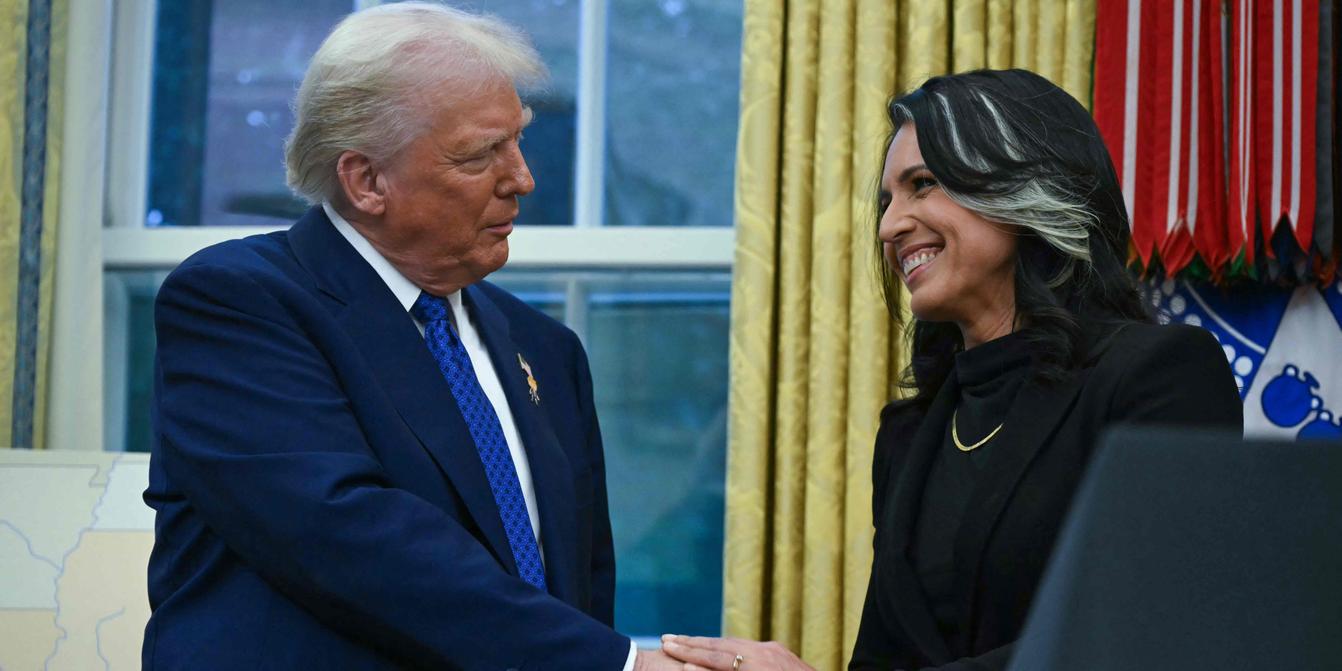
The Director of National Intelligence is, on paper, the most senior intelligence official in the United States — the person who coordinates the seventeen agencies of the intelligence community, who briefs the president on the most sensitive threats facing the country, who sits at the intersection of everything the government knows about what is happening in the world. It is a position of extraordinary access and, in theory, extraordinary influence.
Tulsi Gabbard held that position. And according to reporting from multiple sources familiar with her tenure, she was repeatedly cut out of the decisions that mattered most — sidelined on Iran, excluded from the inner circle on Venezuela, managing an office that had become as much a bunker as a headquarters. Her resignation was, by the time it came, something that people inside the national security apparatus had seen coming for months.
The Iran and Venezuela Exclusions
The specific decisions from which Gabbard was excluded — the Iran nuclear negotiations and the administration's Venezuela policy deliberations — represent some of the most consequential foreign policy choices of Trump's second term. Both involved significant intelligence equities: questions about what the U.S. knew about Iranian nuclear capabilities, about the reliability of intelligence on Venezuelan government actions, about the operational picture that should inform diplomatic and potentially military decisions.
The DNI's role in these processes is not optional. The director is supposed to provide the intelligence community's assessment — the aggregated, coordinated view of what the agencies know and believe — to the policymakers making the decisions. When the DNI is excluded from that process, those decisions are being made without the structured intelligence input the system was designed to provide.
Why Gabbard was excluded depends on who you ask. Administration officials have suggested, in background conversations, that her assessments were not always aligned with what principals wanted to hear — that her office's intelligence products created friction with policy preferences rather than supporting them. Critics of the administration have a more pointed explanation: that Gabbard was cut out specifically because an independent intelligence voice was inconvenient for decisions that had already been made on other grounds.
The CIA Security Detail Problem
Perhaps the most revealing detail in the reporting about Gabbard's tenure is the security detail question. She reportedly refused CIA officers assigned to her protective detail because she did not trust the agency. The DNI — the official nominally responsible for coordinating the intelligence community — did not trust the CIA officers assigned to protect her.
This detail captures something fundamental about the dysfunction of her tenure. The Director of National Intelligence's effectiveness depends almost entirely on relationships — on the trust and cooperation of the agencies she is supposed to coordinate, on her ability to aggregate their products and perspectives into a coherent national intelligence picture. An official who does not trust CIA officers assigned to protect her is an official who almost certainly does not have the working relationships with agency leadership that the position requires.
The CIA has a complicated institutional history and legitimate criticisms have been made of its culture and its conduct. But an intelligence director who begins from a position of institutional distrust toward one of the community's central agencies is not in a position to do the job the position requires. Gabbard's reported attitude toward the CIA is consistent with her public statements over her career, which have often been skeptical of agency assessments and critical of the intelligence community's role in American foreign policy. Those views are defensible as political positions. They are debilitating as an administrative posture for the person who is supposed to lead the community she distrusts.
The Isolation Spiral
Reporting describes Gabbard surrounding herself with a small circle of personal advisers who were not career intelligence officers — people whose loyalty was to her personally rather than to the institutional mission of the intelligence community. This is not an unprecedented management choice for political appointees who enter environments they view as potentially hostile. It is, however, a choice with consequences.
An intelligence director who has walled herself off from the career professionals in her own office and in the agencies she coordinates receives a filtered, curated version of what the intelligence community knows. The career officers who have spent decades developing expertise and relationships are not in the room. The institutional memory and the professional networks that make intelligence assessments reliable are not accessible. What reaches the director is what the small circle of personal advisers chooses to pass through.
In that environment, exclusion from major policy decisions becomes something closer to a natural outcome. If the DNI is not producing intelligence assessments that principals find useful or trustworthy — because the assessments are not grounded in the full depth of what the community knows — principals will find other sources of intelligence input. The DNI becomes advisory rather than essential. And an advisory DNI can be cut out of meetings without institutional consequence.
The Resignation and What Comes Next
Gabbard's departure leaves the DNI position vacant at a moment when the intelligence community's relationship with political leadership is, by most accounts, under significant strain. The pattern of sidelining career professionals, of treating institutional intelligence products with suspicion, of building personal loyalty structures that bypass normal processes — that pattern does not resolve when a single official departs. It reflects the administration's broader posture toward the institutions it nominally leads.
Who Trump nominates to replace Gabbard will signal whether that posture is changing or intensifying. A nominee with intelligence community credibility and relationships would suggest a recalibration. A nominee chosen primarily for personal loyalty and ideological alignment with the administration's view of the "deep state" would suggest the opposite. The intelligence community, and the country's national security decisions, will be shaped by that choice in ways that are not always visible but are consequential.