
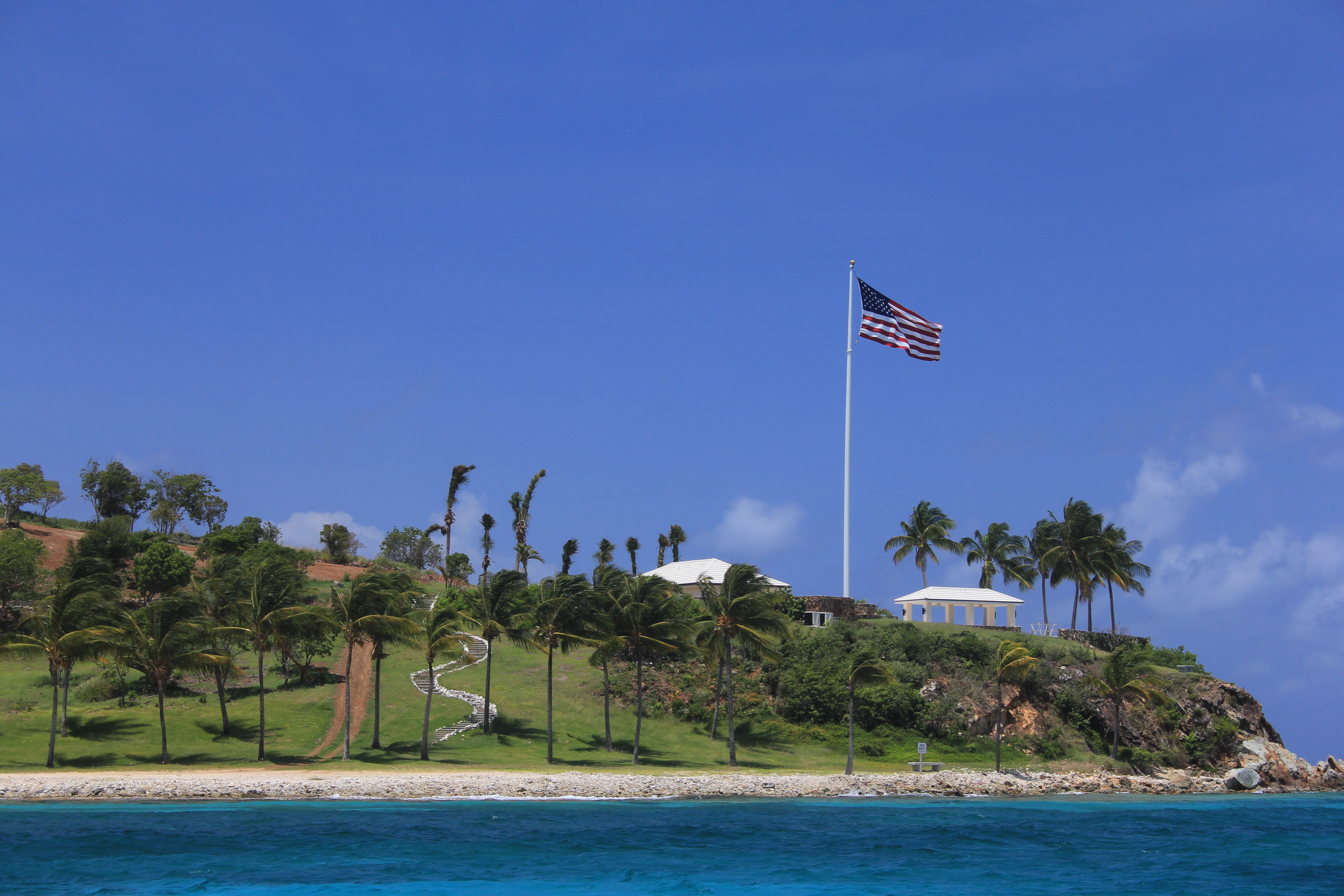
The Island and Its History
Little St. James is a 75-acre island located approximately one mile off the southeastern coast of St. Thomas, in the U.S. Virgin Islands. The island had minimal development when Jeffrey Epstein purchased it in 1998 for $7.95 million from a seller who had held it as a private retreat. Over the following two decades, Epstein invested an estimated $200 million in its construction and development, transforming it into a compound of considerable sophistication: a main residence, multiple guest cottages, staff quarters, a library building, a music pavilion, a helipad, a marina, a network of underground tunnels connecting several structures, manicured beaches, and — among its most discussed and least officially examined features — a distinctive striped structure atop a small hill at the eastern end of the island that observers have variously described as a temple, a gym, or an unspecified outbuilding.
Epstein subsequently purchased the neighboring island of Great St. James in 2016 for $22.5 million. The dual-island compound gave him effective control of the marine approaches and the ability to monitor and control access to his primary residence from multiple directions. The U.S. Virgin Islands, as an American territory, is subject to U.S. federal law, but its geographic remoteness and the practical difficulties of law enforcement access to private islands created a degree of jurisdictional insulation that, according to investigators who worked the case, complicated any potential law enforcement investigation of activities there for years.
The Architecture of Isolation
The geography and infrastructure of Little St. James functioned as a mechanism of control. Access required either a private boat, a helicopter, or Epstein's own aircraft — all of which were owned or chartered by Epstein and all of which could be controlled and monitored. The island had no commercial ferry service, no public access points, and no presence of any governmental authority that was not invited. The practical implication was that young women who arrived on the island arrived entirely dependent on Epstein for their ability to leave.
Former employees and construction workers who spent time on the island during its development years described communication infrastructure that was, by multiple accounts, monitored or controlled. Cell phone signals were weak or unreliable in certain areas. Communication equipment on the island was, according to at least two former employees interviewed by journalists, subject to unusual restrictions about who could access it and when. The specific mechanisms of communication control have not been fully documented in any public record, but the convergent accounts of multiple former employees describe an environment in which the young women present were significantly limited in their ability to communicate with the outside world without Epstein's knowledge or consent.
The island's surveillance infrastructure was extensive. Security cameras covered approaches by sea and air and portions of the island's interior, according to former employee testimony and descriptions by civil attorneys who have litigated against Epstein's estate. The purpose of this infrastructure — whether primarily for security, for monitoring of guests and employees, or for the collection of compromising material that civil attorneys representing victims have alleged was central to Epstein's operation — has not been officially determined.
What Victims Testified Under Oath
At Ghislaine Maxwell's 2021 federal trial, two of the four testifying witnesses described experiences specifically on or related to Little St. James. Carolyn, who testified under her first name pursuant to a partial anonymity order, described traveling to the island on multiple occasions as a teenager and being subjected to sexual abuse there by Epstein and Maxwell. Her testimony described the physical environment of the island in detail that corroborated other accounts, and she described specific buildings and areas of the compound that corresponded to features visible in aerial photographs and satellite images.
In civil proceedings, Virginia Giuffre provided extensive testimony about Little St. James in sworn depositions, some portions of which have been unsealed through litigation. Giuffre described multiple visits to the island over the period of her involvement with Epstein, and she specifically identified individuals she alleged to have encountered there — allegations that have generated separate legal proceedings involving Prince Andrew, among others.
The pattern of victim testimony about the island consistently describes: arrival by private aircraft or helicopter; the immediate establishment of a schedule of activities centered on massage and sexual service; the presence of other young women in similar situations; occasional presence of prominent guests; and a clear understanding that leaving was not possible without Epstein's assistance or cooperation.
The Structure on the Hill
Perhaps the most discussed and least officially investigated feature of Little St. James is the structure that aerial and satellite photography shows positioned on a small hill at the eastern end of the island. The building — which has become commonly known in media coverage as Epstein's "temple" — was characterized in its most prominent photographs by blue and white horizontal stripes on its exterior walls and, in earlier photographs, a gold dome at its apex. Later aerial images suggest the dome was removed or altered at some point, and other construction activity is visible at the structure in photographs taken after Epstein's 2019 arrest.
The building's function has never been officially established. Former employees given access to journalists have provided varying descriptions: a music room is the most common characterization offered by those willing to describe it at all. Other former employees declined to discuss the structure. No law enforcement agency has publicly described conducting an inspection of the building's interior, and no forensic analysis of its contents has been made public. The island was in the possession of Epstein's estate following his August 2019 death, and whatever evidence the structure may have contained was subject to the same questions about preservation and potential removal that investigators have raised regarding Epstein's other properties.
The USVI Government's Relationship with Epstein
One of the more striking dimensions of the Little St. James story is the relationship between the U.S. Virgin Islands government and Epstein during the years of his island's operation. Epstein's business entities registered in the USVI received significant tax incentives through the territory's Economic Development Commission — incentives that, according to civil litigation filed by the USVI attorney general's office in 2020, reduced his tax burden by tens of millions of dollars on the basis of employment and investment claims that the attorney general alleged were fraudulent.
The USVI pursued civil litigation against Epstein's estate following his death, alleging that Epstein had used the territorial tax incentive system to protect proceeds of his trafficking operation and that USVI officials had been deceived about the nature of his activities. In November 2024, the USVI reached a settlement with Epstein's estate for $105 million — one of the largest settlements in the history of the case. The settlement included requirements for ongoing cooperation with investigations and information sharing with law enforcement.
The Cleanup Before Inspection
A significant and unresolved question in the Epstein case involves the period between his July 6, 2019 federal arrest in New Jersey and any law enforcement inspection of his properties, including Little St. James. The island was staffed by employees during this interval — a period of approximately five weeks before Epstein's death. Multiple journalists and civil attorneys representing victims have raised questions about what, if any, materials were removed from the island during this period and whether the evidence that was eventually available to investigators had been fully preserved.
These concerns are not purely speculative. Civil attorneys in the case have alleged in filings that evidence was removed or destroyed at multiple Epstein properties following his arrest. The specific allegation with respect to Little St. James — that surveillance recordings, documents, or other materials were removed during the interval between arrest and death — has not been confirmed by any official finding but has been raised formally in legal proceedings.
The Island After Epstein
Following Epstein's death and the subsequent resolution of legal proceedings against his estate, Little St. James and Great St. James were ultimately sold. The USVI settlement required the estate to liquidate assets, and the islands were listed for sale in 2022. The physical infrastructure that Epstein built over two decades — the residences, the tunnels, the structures whose function remains officially unexplained — passed to new ownership, its evidentiary significance largely unexamined by the authorities who might have systematically documented it.
For the women who were brought to Little St. James as teenagers and young adults, the island's sale does not resolve what happened there or answer the questions that remain open. The physical place can be sold and repurposed. The documentary record of what occurred there — the full extent of who visited, what was recorded, what was done — is what justice would require, and it is precisely what remains most incomplete in the entire Epstein case.