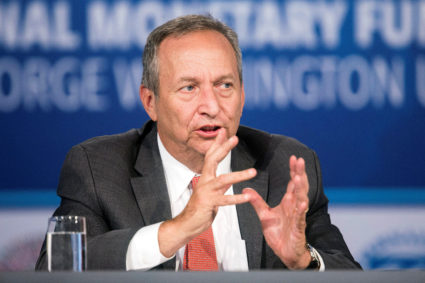
Lawrence Summers has spent his career at the intersection of power and prestige — Treasury Secretary under Clinton, president of Harvard, director of the National Economic Council under Obama, one of the most prominent economists in the world. His name has appeared in the Epstein orbit before, but always at what seemed a plausible distance: the kind of tangential connection that a man of his prominence and social world might have with a wealthy figure who collected relationships across elite institutions.
The emails changed that.
Emails from 2017 through 2019 — after Epstein's 2008 conviction, after the non-prosecution agreement, after the period when any plausible claim of ignorance about who Epstein was had expired — show Summers in correspondence with Epstein that is not tangential and not institutional. It is personal. Summers asked Epstein for dating advice about a young female mentee.
Harvard has announced that Summers will resign from all academic and faculty roles by the end of the school year. His wife's PBS program has been canceled after it emerged that Epstein had funded it. The career built over decades has collapsed in the span of months. The emails are why.
The Nature of the Emails
The specific content of the emails — the language Summers used, the nature of the "dating advice" he sought, the details of who the young female mentee was — has not been fully reported. What has been disclosed is enough to establish the basic character of the exchange: a man of enormous institutional power seeking counsel from a convicted sex trafficker about his relationship with a younger woman in his professional sphere.
The implications of that exchange accumulate quickly. Summers knew, by 2017, exactly who Epstein was. The 2008 conviction was public record. The Palm Beach investigation, the plea deal, the terms of Epstein's sex offender registration — all of it was documented and available. A man of Summers's sophistication, with his access to legal counsel and his professional immersion in institutional governance, cannot plausibly claim ignorance of what Epstein had been convicted of when he was writing those emails.
He asked him for dating advice about a young female mentee anyway. The question of what that reveals about Summers's judgment, his values, and his understanding of the power dynamics involved in a senior academic's relationship with a young mentee is one that Harvard has now answered in institutional terms: he no longer works there.
The PBS Connection and the Funding Question
The cancellation of his wife's PBS program introduces a second thread that raises its own questions. The program was funded, at least in part, by Epstein. The specific amount of Epstein's contribution, the mechanism through which it was made, and whether the Summers household was aware of the source of the funding are questions that have not been fully answered in public reporting.
What the funding connection establishes is that the Summers-Epstein relationship was not a single-direction professional correspondence. It extended to the financial support of projects connected to Summers's family. Epstein, characteristically, used money not just to access individuals but to create webs of obligation and mutual interest that made those relationships more durable and more difficult to cleanly exit.
Whether Summers understood the nature of the web he was in — whether the PBS funding created a sense of obligation that shaped his willingness to maintain the correspondence, to seek advice, to sustain a relationship with a man whose crimes were already public — is unknowable from the outside. What is knowable is that the relationship persisted and deepened after the moment when it should, at minimum, have been severed.
Harvard's Response and What It Means
Harvard's decision to require Summers's resignation is significant both for what it does and what it doesn't do. It removes him from his institutional positions. It sends a clear signal about what the university considers compatible with its standards for faculty conduct. It is the most concrete institutional accountability action to result from the Epstein emails involving a named senior figure at a major university.
It is not, however, a legal accountability action. Summers has not been charged with any crime. The emails do not establish that he participated in Epstein's abuse — they establish that he maintained a relationship with Epstein after his conviction and sought his advice in ways that reflect, at minimum, catastrophically poor judgment. Harvard's response is calibrated to that finding: it is institutional, not criminal.
The distinction matters for understanding what kind of accountability the Epstein reckoning is producing at the university level. MIT lost Joi Ito. Harvard has now lost Summers. The Epstein document releases are producing resignations and institutional consequences for senior figures who maintained relationships with him after his conviction. They are producing far fewer criminal consequences for the people who participated in or enabled his actual crimes.
The Broader University Accountability Problem
Summers is the most prominent in a line of university-affiliated figures whose Epstein connections have produced institutional consequences. The pattern at Harvard, MIT, and other institutions is consistent: donations accepted after the 2008 conviction, relationships maintained in ways that allowed Epstein to present himself as a respected figure in academic and intellectual life, and oversight systems that failed to catch what was happening until the post-2019 document releases made it visible.
What has not happened — at Harvard, at MIT, or elsewhere — is a serious institutional examination of why those oversight systems failed. What procedures allowed a convicted sex offender to donate to university programs, fund faculty research, attend campus events, and cultivate personal relationships with senior academics for a decade after his conviction? What changes have been made to ensure it cannot happen again? What accountability exists for the officials who maintained those relationships and who, in some cases, worked actively to conceal Epstein's donations from university leadership?
The resignations answer the question of what happens to the individuals most directly implicated. They do not answer the systemic question. Lawrence Summers is leaving Harvard. The conditions that allowed his Epstein correspondence to continue for years, and allowed Epstein's money to fund his wife's PBS program, remain largely unexamined.