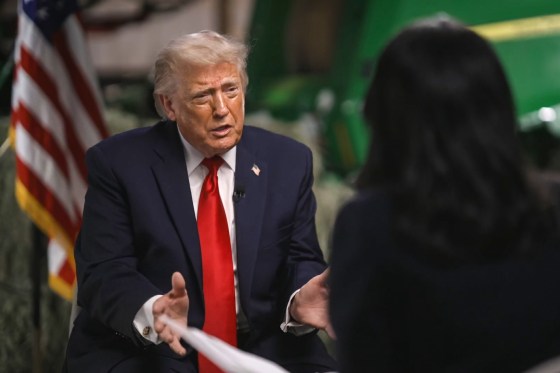
Donald Trump sat down with Meet the Press on Sunday for one of the most significant television interviews of his second term — a wide-ranging conversation that focused heavily on the Iran conflict, his claims about the military situation on the ground, and his timeline for ending a war that has now lasted more than three months and driven oil prices to $100 a barrel.

The claims he made were specific, confident, and consequential. Iran's missile arsenal, he said, has been "largely decimated" by the strikes of Operation Epic Fury. The war, he told the interviewer, would be ending "very soon." He expressed confidence that the ceasefire terms he sent back with tougher conditions would be accepted by Tehran, and suggested that Iran's leadership understands it has no viable path to continued military confrontation.
Military analysts, intelligence veterans, and foreign policy observers spent Sunday and Monday parsing those claims against the available evidence. The picture that emerges is complicated — some of Trump's assertions are supported by the open-source record, others are contested, and some raise questions about whether the president's public statements reflect his actual intelligence picture or a strategic communication effort designed to accelerate Iranian capitulation.
The Missile Arsenal Claim
Trump's assertion that Iran's missile arsenal has been "largely decimated" is the claim that has attracted the most scrutiny. Operation Epic Fury's strikes in February targeted, among other things, Iranian missile production facilities, storage sites, and launch infrastructure. The strikes were extensive and, by all public accounts, more successful than many analysts predicted in degrading Iran's ballistic missile capabilities.
But "largely decimated" is a specific claim that the intelligence community has not publicly confirmed at that level of confidence. Open-source analysis of satellite imagery since the February strikes shows significant damage to known missile facilities. It also shows that Iran's missile force, while degraded, has continued to function — the country has launched missiles at Israeli and American targets in the months since the initial strikes, demonstrating that whatever was decimated was not everything.
The distinction matters strategically. A missile arsenal that is degraded by fifty percent is a very different military situation than one that is decimated — effectively destroyed. If Iran retains significant residual missile capability, the ceasefire negotiations have a different character than if it has been reduced to minimal threat. Trump's framing, whether accurate or not, serves his negotiating strategy: it tells Iranian leadership that they are negotiating from a position of military weakness, not strength.
The "Very Soon" Timeline
Trump's suggestion that the war will end "very soon" has generated both hope and skepticism. The hope is grounded in the fact that ceasefire negotiations have been ongoing for weeks and that, by multiple accounts, the broad outlines of a deal are understood by both sides. The skepticism is grounded in Trump's own recent rejection of the memorandum of understanding that negotiators had described as "mostly agreed," and in the history of predictions about imminent resolution that have not materialized.
The "very soon" framing is also a strategic communication tool. If Iranian leadership believes Trump is confident enough in American military superiority to publicly predict a swift resolution, the implicit message is that they should accept terms before their negotiating position deteriorates further. Whether that message is received as intended — as pressure to settle — or as a signal that Trump is impatient enough to be pressured himself is a matter of how Tehran's decision-makers read American psychology.
The Domestic Political Context
The Meet the Press interview did not happen in a vacuum. It happened in the context of oil at $100 a barrel, consumer sentiment declining, and a midterm election cycle in which the Iran conflict's economic costs are becoming a political liability. A president who can credibly claim the war is almost over — who can point to a decimated enemy arsenal and a ceasefire on the horizon — is a president who can run on ending a war rather than managing one.
Trump's political interest in the war ending quickly is obvious and does not make his claims false. Presidents communicate strategically in part because strategic communication is a legitimate tool of statecraft. The question is whether the gap between the claims and the military reality, if one exists, undermines the strategy or reflects a genuine assessment that has not yet been confirmed by open sources.
The answer will arrive with events rather than analysis. If a ceasefire is signed in the next few weeks, Trump's Sunday claims will look prescient. If the talks collapse and strikes resume, they will look like premature optimism that strengthened Iran's negotiating hand. The interview is on the record. History will judge it by what happens next.