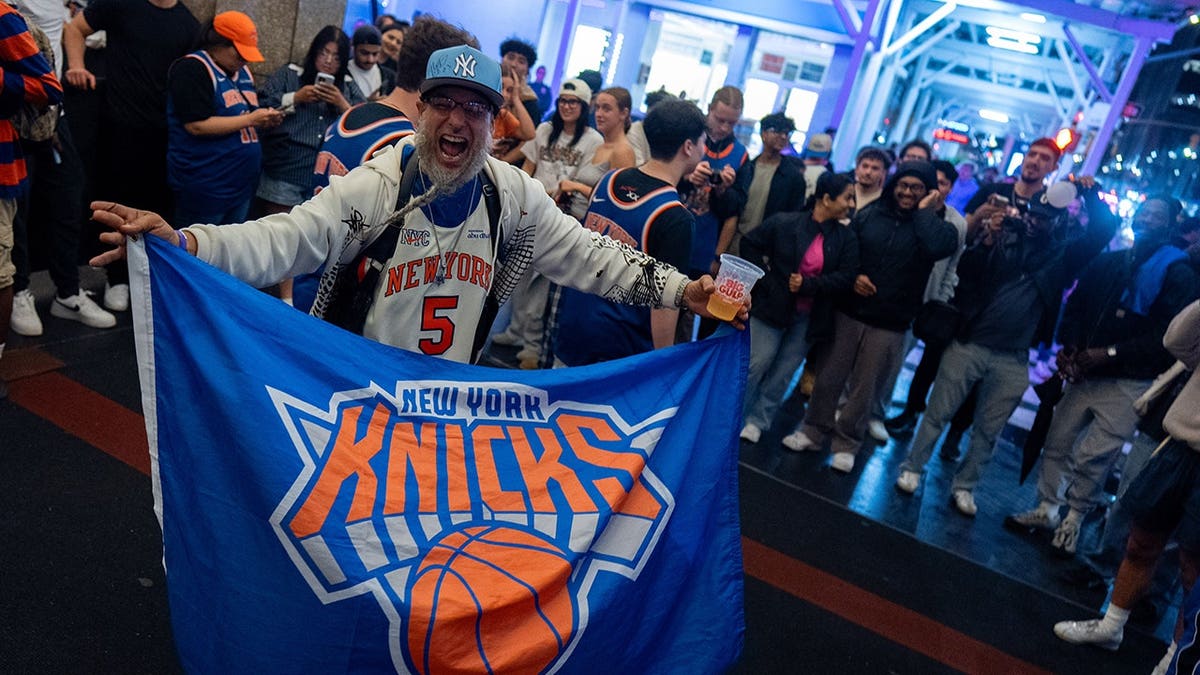
The final buzzer sounded and Jalen Brunson stood at center court, arms raised, and the noise coming out of Madison Square Garden was the kind you don't manufacture. Twenty-seven years of waiting, of losing, of near-misses and embarrassments and ownership controversies and draft busts and coaching carousels — all of it discharged in a single roar that rattled windows on Seventh Avenue.
The New York Knicks are going to the NBA Finals.
They swept the Cleveland Cavaliers 130-93 in Game 4 of the Eastern Conference Finals on May 26, 2026. They did it by an average margin of 23.7 points. They extended their playoff winning streak to eleven games. They won every game but one by double digits. This was not a scrappy upset. This was a team that spent four years being built correctly finally doing what it was built to do.
How They Got Here
The last time the Knicks were in the NBA Finals was 1999. Latrell Sprewell, Patrick Ewing who didn't make it to the Finals that year due to an Achilles tear, Allan Houston's floater that beat Miami. They lost to the San Antonio Spurs in five games. The city has been waiting ever since through seasons that ranged from mediocre to actively humiliating — the Isiah Thomas years, the Andrea Bargnani trade, the Carmelo Anthony era that produced talent but never a champion, the lottery years, the James Dolan ownership saga that became a running national sports media joke.
What changed was the construction of something patient and coherent. Jalen Brunson arrived in the summer of 2022, a point guard dismissed by some as a complementary piece, and proceeded to prove that he was a franchise player — not in the flashy, contract-driven, superstar-recruitment way that had defined the Knicks' failed attempts to compete, but in the grinding, game-by-game, series-by-series way that actually wins championships. Karl-Anthony Towns came via trade in 2024, a center whose offensive versatility opened the floor in ways that multiplied what Brunson could do. The supporting cast was built through the draft, through smart role-player acquisitions, through the kind of organizational patience that had been conspicuously absent from this franchise for most of the previous quarter century.
The result is a team that wins ugly when it has to and wins by thirty when it doesn't. A team that has been the best in the Eastern Conference since January. A team that swept its conference finals opponent while everyone was still asking whether they were quite ready.
Brunson's Moment
Jalen Brunson was named the Eastern Conference Finals MVP. The selection was not debated. He averaged twenty-six points, eight assists, and five rebounds across the four games, with a player efficiency rating that put him in the company of the great playoff performers of the last decade. More than the numbers, he was the conductor of a team that played its best basketball when the moment was largest.
There is a particular pleasure in watching a player prove people wrong at the highest possible level. Brunson was not recruited to New York as a savior. He was recruited as a very good player who might be enough alongside the right supporting cast. The case for him as an elite player — not just a very good one, but genuinely elite — has been building for two years. These playoffs have closed it.
The narrative also matters in a city that runs on narratives. New York has not had a sports figure who feels genuinely its own, who chose the city and made it better and stayed through difficulty, in a long time. Brunson has become that figure. The city knows it. The way Madison Square Garden responds to him — the particular frequency of the noise — is different from the way it responds to other players. It is recognition, and gratitude, and something that operates below the level of sports entirely.
Karl-Anthony Towns and What He Adds
Karl-Anthony Towns scored nineteen points and grabbed fourteen rebounds in the clinching game. The line does not capture what he does for this team. Towns is a seven-footer who can make threes, handle in space, set screens that collapse defenses, and protect the rim when he has to. He is, when healthy and engaged, one of the five most versatile offensive players in the league. Paired with Brunson, he creates problems that most defensive schemes cannot solve: if you hedge on Brunson's drives, Towns is open at the arc; if you drop back to contain Towns, Brunson has space to operate in the mid-range and at the rim.
The Cavaliers had no answer for the combination. The Thunder or the Spurs, whoever emerges from the Western Conference Finals, will face the same problem. Neither team has a defensive profile that clearly maps onto what the Knicks do offensively. The Finals start June 3. The Knicks will have home court if the Thunder hold their series lead.
What This Means for New York
It is easy to underestimate what sports mean to a city until the right team does the right thing at the right time. New York has had champions recently — the Yankees, the Giants, the Rangers who won the Cup in 2024. But the Knicks occupy a particular place in the city's self-image, something rooted in the Garden's history, in the 1970s championship teams, in the Patrick Ewing era when the team was the loudest thing in a loud city and still couldn't get over the top.
The people filling the Garden for these playoff games — the ones who were there in 1999, the ones who kept buying tickets through the Isiah Thomas disaster, the ones who stayed loyal through a quarter century of losing — they are not watching a sports team. They are watching something that belongs to them. The Knicks going to the Finals is not just a basketball result. It is the city getting something back that it did not realize, fully, how much it had missed.
The Finals begin June 3. New York is ready.