
The FBI's Case Against Epstein
In the spring of 2005, an investigator with the Palm Beach Police Department named Detective Joseph Recarey received a complaint from the mother of a 14-year-old girl who had been taken to the Palm Beach home of Jeffrey Epstein, ostensibly for a paid massage, and subjected to sexual abuse. Recarey opened an investigation that over the following two years would identify more than 36 victims — girls as young as 14, recruited primarily through a network of older girls who were paid $200 for each referral — and document a trafficking operation of a scale and systematic character that the Palm Beach Police ultimately referred to the Federal Bureau of Investigation as a federal matter.
The FBI's Miami field office took the referral and expanded the investigation substantially. By September 2007, federal investigators had produced a draft indictment running to 53 pages that described Epstein's operation in detail, named specific victims and co-conspirators including Ghislaine Maxwell, and recommended charges — including sex trafficking of minors, conspiracy, and use of interstate commerce in furtherance of illegal sexual activity — that carried mandatory minimum sentences and could have resulted in a prison term of decades or more. The evidence base, by accounts of investigators who worked the case, was strong, specific, and corroborated by multiple independent witnesses.
The Secret Negotiations
The 53-page draft indictment was never filed. What happened instead — over the following months, through a process that the Miami Herald's Julie K. Brown later documented in her landmark 2018 investigative series — was a secret negotiation between the U.S. Attorney's office for the Southern District of Florida and Epstein's legal team. Epstein had assembled a formidable group of attorneys: Jay Lefkowitz, a former domestic policy advisor in the George W. Bush White House; Martin Weinberg, one of Boston's most respected criminal defense attorneys; Roy Black, the Miami criminal defense lawyer who had successfully defended William Kennedy Smith; and, at various stages, Harvard Law School professor Alan Dershowitz.
The negotiations proceeded over a period of approximately fourteen months. They involved unusual access by Epstein's defense attorneys to federal prosecutors — access that multiple former Justice Department attorneys who reviewed the record have described as inconsistent with standard prosecutorial practice. Epstein's attorneys met repeatedly with Acosta and his staff, submitted detailed legal memoranda contesting the government's case, and played an active role in shaping the final terms of an agreement that, by the standards of what the FBI's investigation had recommended, was extraordinary in its leniency.
The Terms That Protected a Network
The agreement signed by Epstein and the U.S. Attorney's office in September 2008 contained the following core provisions: Epstein would plead guilty in Palm Beach County to two state charges — solicitation of prostitution and solicitation of prostitution from a minor, the second charge acknowledging the age of at least one victim. He would serve 18 months in the Palm Beach County Jail, not a federal institution. He would be granted work release privileges allowing him to leave custody for up to 12 hours per day, six days per week, for work-related purposes — effectively allowing him to operate from his Palm Beach office for most of the workday while nominally incarcerated.
All federal criminal charges would be permanently dropped, with prejudice. Federal immunity from prosecution would be extended not only to Epstein himself but to "any potential co-conspirators" — a provision whose language was sweeping and whose effect was to immunize, without naming them, any individual who had participated in Epstein's operation. The agreement was executed as a sealed document. It was not filed in any federal court. It was deliberately kept from the knowledge of Epstein's victims — a decision that a federal judge would later find to have violated the Crime Victims' Rights Act of 2004.
Epstein served approximately 13 months of his 18-month sentence before being released to "community control" — a form of house arrest — in July 2009. He registered as a sex offender in Florida and subsequently moved between his residences in New York, Palm Beach, New Mexico, and the U.S. Virgin Islands without significant restriction.
The Violation of Victims' Rights
The Crime Victims' Rights Act, enacted by Congress in 2004, establishes specific rights for crime victims in federal proceedings, including the right to be reasonably heard at any public proceeding in the district court, the right to confer with prosecutors about the case, and — critically — the right to receive timely notice of any plea agreement or other resolution. The act imposes affirmative obligations on federal prosecutors to protect these rights.
Julie K. Brown's 2018 reporting in the Miami Herald revealed that Epstein's victims had been deliberately kept uninformed of the non-prosecution agreement's existence and terms during the period of its negotiation and execution. This was not an oversight. According to Brown's reporting, based on documents and interviews with officials involved in the case, there were deliberate decisions made to prevent the victims from learning about the agreement before it was finalized.
In February 2019, U.S. District Judge Kenneth Marra, who reviewed the agreement in the context of a civil lawsuit filed by Epstein's victims, issued a ruling finding that the government had violated the Crime Victims' Rights Act. Judge Marra wrote that prosecutors had engaged in a "conspiracy of silence" with Epstein's defense attorneys — the most direct language any federal judge had yet applied to the agreement. The ruling did not void the agreement or restore the possibility of prosecution; it found that victims had legal rights that had been unlawfully denied them.
Acosta's Explanations and the Intelligence Claim
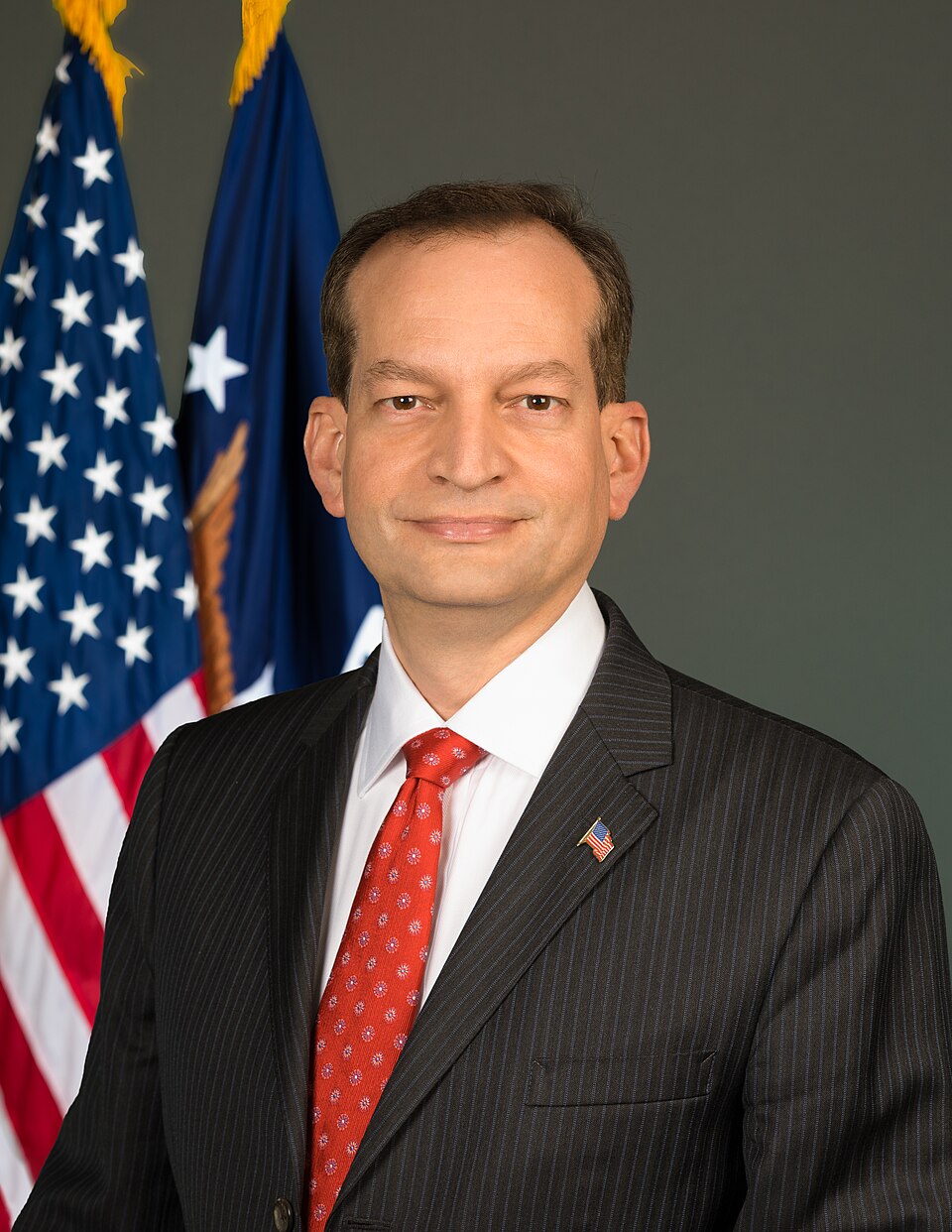
Alexander Acosta offered multiple explanations for the agreement over the years following its execution and exposure. In a press conference on July 10, 2019, convened as pressure from the Miami Herald's reporting and Epstein's new federal arrest mounted, Acosta made a statement that has become one of the most significant — and most inadequately investigated — claims in the entire Epstein case. He said, regarding the 2008 negotiations, that he had been told by individuals he declined to name that Epstein "belonged to intelligence" and that he had been instructed to "leave it alone."
This statement was made voluntarily by the senior federal law enforcement official who made the agreement. It was made at a press conference, on the record, in front of cameras. It suggests that a decision to allow a serial child sex trafficker to escape federal prosecution may have been influenced by his alleged relationship with an intelligence agency. The statement has not been officially investigated, officially corroborated, or officially dismissed. Congressional requests for records relating to Acosta's statement have not produced responsive documents. The FBI and CIA have not commented on it.
The Appointment to Trump's Cabinet
In February 2017, President Donald Trump nominated Alexander Acosta to serve as Secretary of Labor. The Epstein non-prosecution agreement was known at the time of Acosta's nomination — it had been the subject of media reporting, and victims' attorneys had been litigating its validity. The Trump administration proceeded with the nomination despite this record, and Acosta was confirmed by the Senate on April 27, 2017, by a vote of 60 to 38.
Acosta served as Labor Secretary for more than two years. He oversaw the Department of Labor's worker protection functions, including oversight of the Wage and Hour Division, the Occupational Safety and Health Administration, and the Employee Benefits Security Administration, during a period in which critics documented significant rollbacks in worker protections and enforcement activity. He resigned on July 19, 2019, under sustained pressure following the Miami Herald's republication and expansion of its Epstein reporting coinciding with Epstein's new federal arrest thirteen days earlier.
What the Agreement Cost
The Acosta agreement had a direct human cost that is calculable in terms of specific individuals harmed. In the decade between 2008 and Epstein's 2019 arrest, Epstein continued to operate. New victims were created during those years who would not have been victimized had Epstein been serving the federal prison sentence that the FBI's investigation had recommended. The number of additional victims who suffered harm during those ten years because of the agreement's leniency has never been officially counted.
The broader cost — to the principle of equal justice, to the credibility of federal prosecution as a tool of accountability, and to the women whose victimization was formally characterized as prostitution rather than trafficking of minors, with all that implies about how their harm was weighed against the interests of the powerful man who had harmed them — is incalculable in a strict sense but real in every other.